
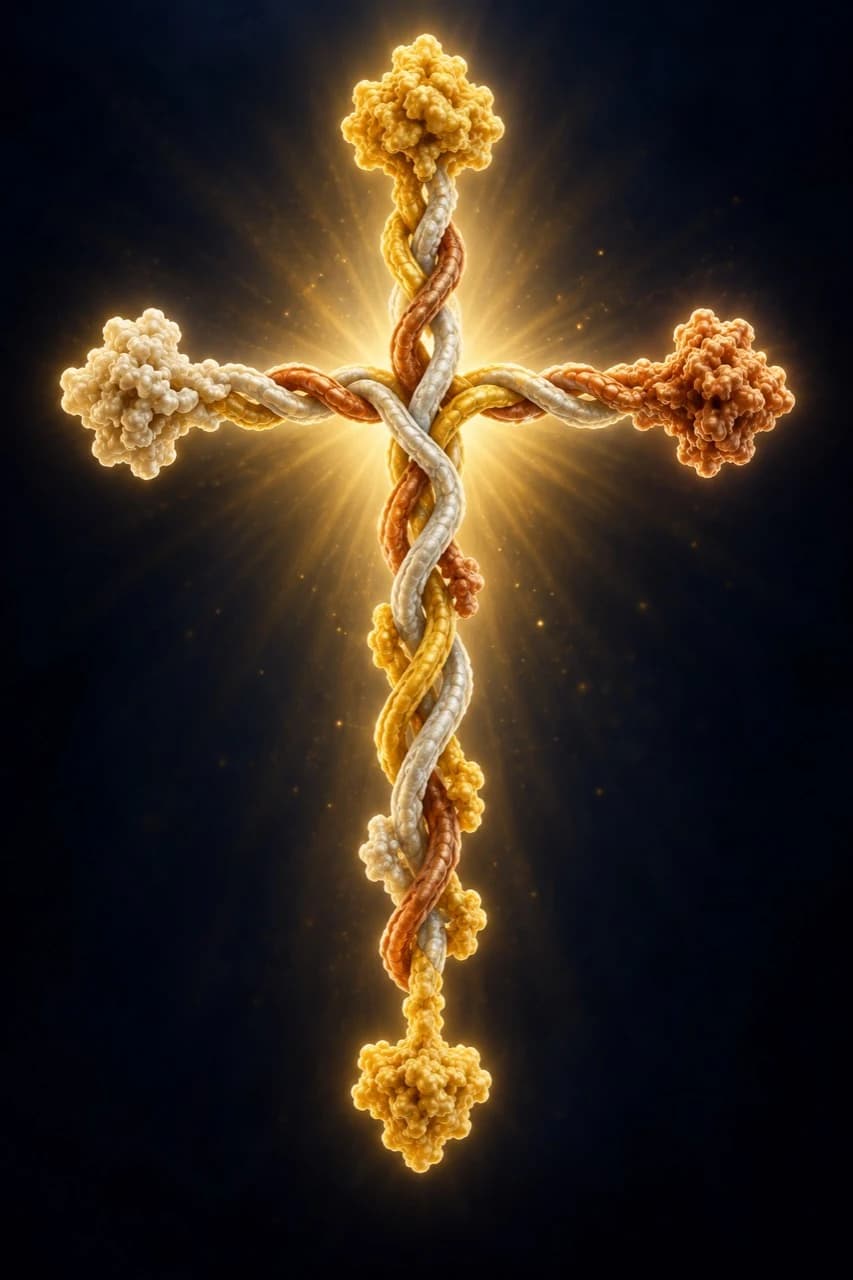
What laminin is.
Laminins are a family of large extracellular-matrix glycoproteins. They are major components of basement membranes—the thin, highly organised layers of matrix beneath epithelial and endothelial cells and around structures such as muscle fibres, nerves, and fat cells.
A laminin molecule is assembled from three different protein chains: one alpha, one beta, and one gamma chain. In classic laminin-111, the chains join into one long arm and three shorter arms. Those short arms participate in self-assembly, while the end of the long arm binds cell-surface receptors such as integrins and dystroglycan.1,3
Laminin is therefore not merely passive “glue.” Together with collagen IV, nidogen, perlecan, receptors, and other partners, laminins help organise basement membranes, anchor cells, transmit signals, and support tissue formation, stability, and differentiation.1,3
Why does it look like a cross?
Early rotary-shadowing electron microscopy showed purified laminin as a flexible, asymmetric, cross-like molecule. That classic image is scientifically grounded: researchers describe laminin-111 as cruciform or cross-shaped.1,2,4
The familiar textbook diagram is still a simplified representation. Laminin molecules flex, assemble into networks, and exist in multiple isoforms. Some family members have shortened arms and are better described as T-shaped or rod-like. Laminin is not a collection of countless rigid Christian crosses stamped inside every cell.4
What Paul means by “hold together.”
Colossians 1:15–20 is a proclamation of Messiah’s supremacy. All things were created by Him and for Him (verse 16); He is before all things, and all things have their continuing coherence in Him (verse 17); He is the head of the body and firstborn from the dead (verse 18); and God reconciles through the blood of His cross (verse 20).
“Hold together” does not mean that Jesus is one material component among other components. It means that creation has its origin, order, continued existence, purpose, and final reconciliation in the Son. Hebrews 1:3 speaks similarly of the Son “upholding all things by the word of his power,” while John 1:3 declares, “All things were made by him.”
Laminin helps particular tissues assemble and function through discoverable biological processes. In that limited sense, it can illustrate the ideas of connection, support, and ordered coherence. Christ’s sustaining work is infinitely greater: every process, every creature, and every moment of existence depends upon Him. Science describes mechanisms within creation; Scripture reveals creation’s Lord.
Wonder without overclaiming.
Christians may receive laminin’s striking form as a prompt to wonder at the wisdom woven into embodied life. Yet we should not make faith depend on an image that can be oversimplified. The apostolic foundation of the Gospel is the historical witness that Christ died for our sins, was buried, and rose bodily from the dead (1 Corinthians 15:3–8).
The cross-shaped image can point our imagination toward Jesus; it cannot carry the full weight of Christian apologetics. Our confidence rests in the crucified and risen Messiah. Our study of laminin then becomes an act of attentive gratitude: learning how wonderfully creation is ordered while giving the Creator, rather than the molecule, the glory.
Study notes
References and further reading
- 01
Hohenester, E., & Yurchenco, P. D. (2013). Laminins in basement membrane assembly. Cell Adhesion & Migration, 7(1), 56–63.
DOI 10.4161/cam.21831 - 02
Engel, J., et al. (1981). Shapes, domain organizations and flexibility of laminin and fibronectin. Journal of Molecular Biology, 150(1), 97–120.
DOI 10.1016/0022-2836(81)90326-0 - 03
Yurchenco, P. D. (2011). Basement membranes: cell scaffoldings and signaling platforms. Cold Spring Harbor Perspectives in Biology, 3(2), a004911.
DOI 10.1101/cshperspect.a004911 - 04
Hohenester, E. (2019). Structural biology of laminins. Essays in Biochemistry, 63(3), 285–295.
DOI 10.1042/EBC20180075
Biblical texts: Colossians 1:15–20; John 1:1–3; Hebrews 1:1–3; 1 Corinthians 15:3–8; Psalm 19:1. The featured quotation from Colossians 1:17 is from the New International Version (NIV); other direct biblical quotations are from the King James Version.